
Photo report by Norbert Senf
Driving down - visit to Old Salem, NC
Ron Karson and I left from Mississauga, west of Toronto, on Friday April 14 Ron is a stone mason from Ontario who is interested in heaters and bakeovens On the previous Tuesday, we had both attended the ASTM meeting in Toronto, followed by a heater core installation in Mississauga.
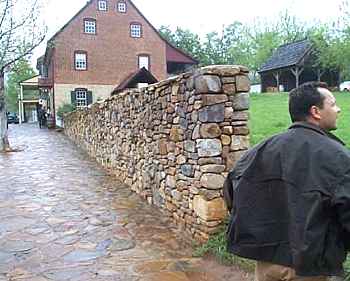
In North Carolina, we stopped at Old Salem. Here Ron checks out the workmanship on a stone wall. The large building is the Winkler Bakery built in 1800. The attached small roof houses the bakeoven.
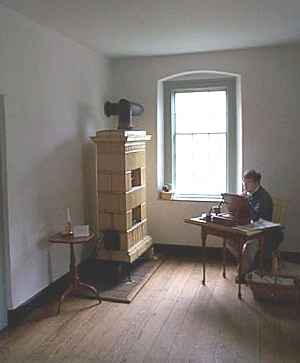
Old Salem was settled by Moravians, who were Protestant Germans from Czechoslovakia. They are still well-known for their pottery. Shown is an original coal burning Kachelofen, located in the Single Brothers House, which was built in 1769.
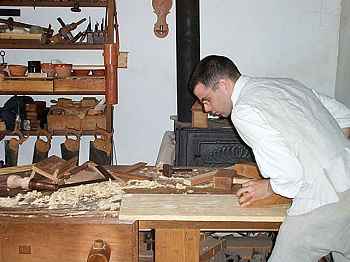
Woodworking shop in the Single Brothers House.

Detail of the tool used to cut threads in wood, such as for a woodworker's vise.

Pewter shop. The melting pot is located in the fireplace. The castings are finished by scraping and filing by hand, and sold in the giftshop.

Reproduction of an early stove. The tiles are slip cast in plaster molds. Note the damper detail.
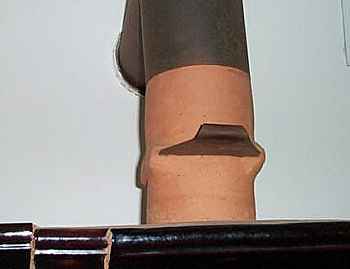
Damper detail - custom terra cotta tile.

Main kitchen. Cookstove (not visible) at left, cooking fireplace in centre, bakeoven on right. Note smoke hood over fireplace.

Cookstove. The cast iron pots are quite deep. Note location of firebox door.
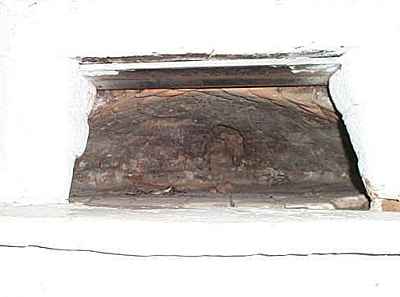
Interior of bakeoven. Gases exhaust at rear, near bottom.
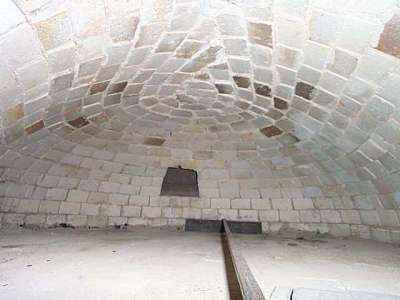
Larger domestic bakeoven. Gases exhaust at rear, and are routed back over the top of the oven, and exhaust into a regular chimney. Dan Fisher, who we met a few days later at the MHA meeting, told me that the Amish call this a "squirrel tail" oven.

Fireplace in a barn. Note the 90 degree twist in the chimney.
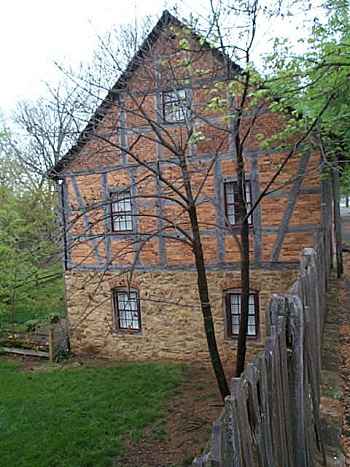
Typical heavy timberframe construction with masonry infill.

Interesting window sill detail.
Setting Up
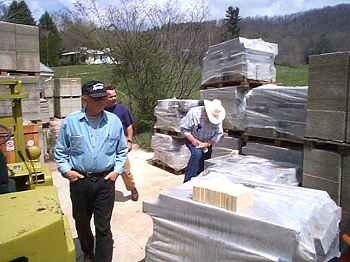
After meeting at an airport hotel near Asheville the previous day, a number of members drove to Tom Trout's place near Wildacres to get materials for the upcoming bricks and mud sessions. Ben Sotero, Ron Karson, and Jerry Frisch check out the interesting bits and pieces.

Interesting!
First Session
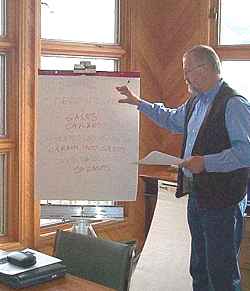
Ernst Kiesling came from Nova Scotia for a full day's presentation on the Austrian system of Kachelofen calculations that he developed.
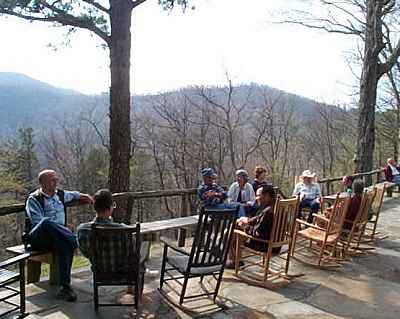
Relaxing after the first day's sessions on the patio overlooking the Smokey Mountains.
Bricks and Mud I: Clearances to Combustibles Testing
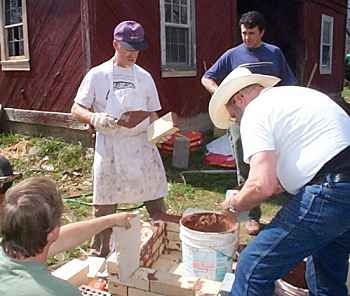
Ben Hurd, Albie Barden, and Jerry Frisch start building the heater for clearances to combustibles testing.
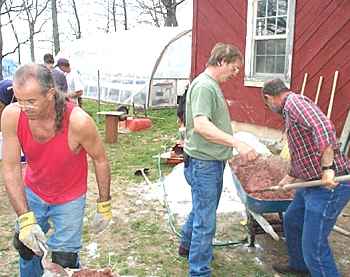
Pat Manley starts on a bakeoven while Ben Hurd and Gary Hart mix clay/sand mud.

Rod Zander and Albie Barden study Jerry's technique.
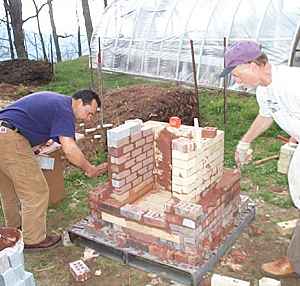
Ron Karson lays up the 8" soapstone left firebox wall. Albie Barden works on the 8" brick right wall. The rear wall is 4.5" firebrick.
More Meetings

Pat Manley presents Jerry Frisch with one of his handcarved soapstone heaters in recognition of Jerry's donation to MHA's fundraising campaign.

Jerry with his new heater
Bricks and Mud II: Pizza Oven

Pat Manley builds the base for the pizza oven. Tony Cuoco and Marty Pearson help out.

Pat talks about oven construction as Tony Cuoco, Walter Kelly, and John LaGamba listen.
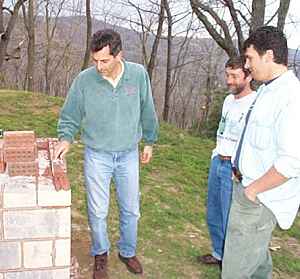
John LaGamba demonstrates his trowel technique to Tony and Walt.
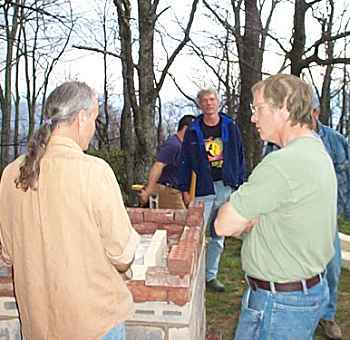
Pat Manley, Tom Trout, and Ben Hurd.
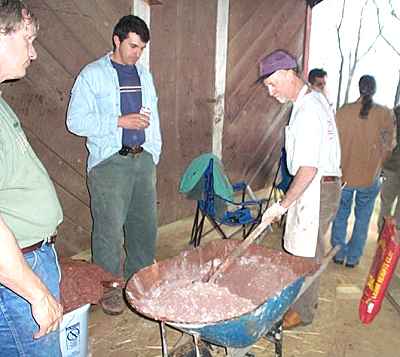
Albie demonstrates clay mud mixing.
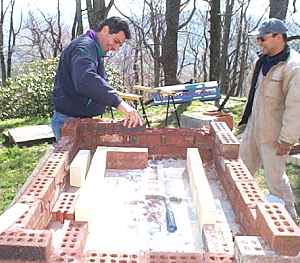
Ron Karson gives John LaGamba some tips on bricklaying as a livelyhood.
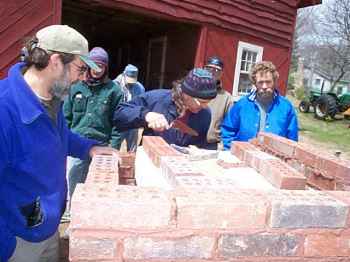
The oven progresses. Peter Solac and Mary Pearson help.

View of the precast oven arch. Ben Sotero, Dann Carnes and Peter Solac listen to Pat.
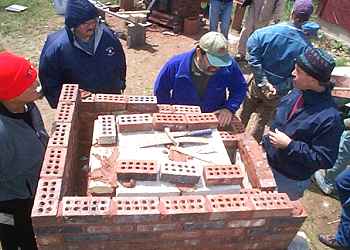

Detail of flue run above oven. This photo was taken during teardown, just after the flue liner was removed. A permanent oven would have had insulation around the bake chamber.

Would you really want to mess with these guys?
Clearances to Combustibles Testing

Dann Carnes and Albie Barden watch the curing fire. Weather on the mountain top was quite changeable, as the attire indicates.

The 8" soapstone test panel is visible. It is isolated from the back wall by a strip of insulating board.

Curing fire in the bakeoven. Heater is visible in the background.

Ron Karson and Jerry Frisch with point-and-shoot infrared thermometers.

Lopez Labs field setup. Jerry reads the ambient surface temperature of three different bricks. Combustion analyzer is in the black case at rear. Laptop computer in front. Also present are a wood moisture meter, digital camera, and thermo-anemometer.
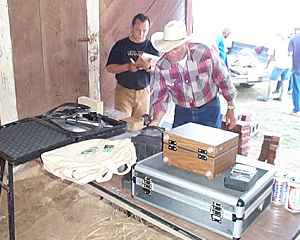
Ron Karson records readings. The 8" soapstone/brick clearance comparison was quite interesting.

Ben Sotero takes a surface temperature reading. The infrared thermometer is point-and-shoot, and tales a reading instantly.

Pat Manley was on the fuelling documentation team. Every piece was weighed and measured for circumference with a cloth tape (this provides surface to volume data). Each fuel load was documented photographically.
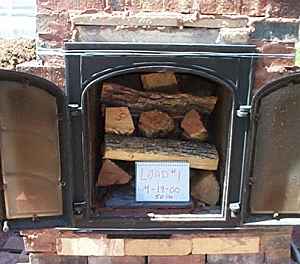
First load stacked in the firebox.
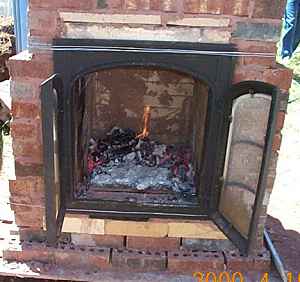
Ready for a reload

Pat Manley reloads. The first test consisted of 4 back-to-back burns of 50 lbs each (200 lbs total). We helped ourselves to Tom Trout's primo stash of seasoned hardwood (Thanks, Tom). Fuel moisture was 14%.


Weather during the first test was sunny and calm. Marty Pearson checks the flueliner, which was running at about 500 F on the surface.

Relaxing after a strenuous session of temperature taking.
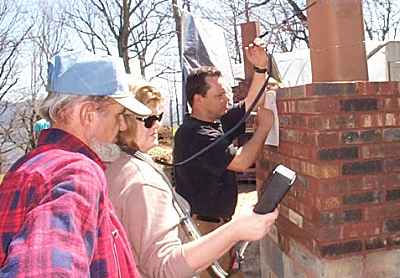
Ron Karson and Rebecca Carnes perform a flue gas analysis as Dan Fisher looks on.
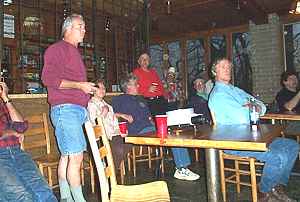
In the evening, Pat Manley gave a slide presentation on his recent stovebuilding trip to Guatemala. It was very moving.
Bricks and Mud III: Hands on Certification Tests

Marty Pearson builds a section of brick chimney for the practical portion of his MHA Heater Mason Certification.

Albie Barden does his hands on test.
Pizza Time!


The pizza oven after a second charge is burning down.
Just about ready.

Tony and Bev prepare the toppings.
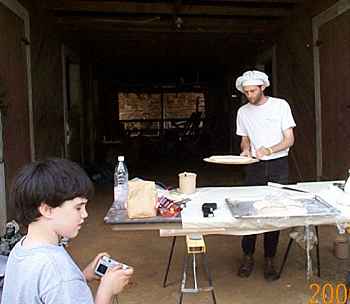
Wildacres' chef Thomas Broadway was hired to do the honors. He had never baked in a brick oven before, and was very impressed. Gavin Custer snaps a picture.

Pat checks the oven with some cornmeal. The first handful spontaneously burst into flames --- too hot.

The first pizza goes in. Tom Trout had prepared 12 pizza shells ahead of time.
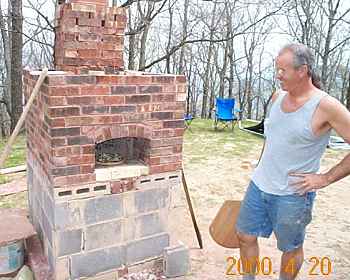
Looking good.

Smelling good.

Thomas checks the crust on the first pizza. We ate 11 pizzas between lunch and dinner. As John LaGamba pointed out, we only spent 3 hours out of the whole day not eating.

A keg of Heiniken arrived just in time.
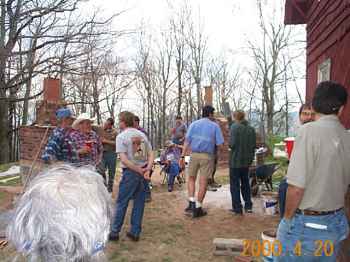

Pizza party. A pizza oven is a natural social focal point.

Tearing down.
No Comments