
Pat Manley's stovebuilding trip to Guatemala
I recently returned from a few weeks in the highlands of Guatemala building cement block and brick cookstoves in a relocated Mayan Indian village called Ixtahuacan, just west of, and 3000 feet higher than nearby Xela. These cookstoves are particularly appropriate at higher elevations, where they also benefit from the retained heat in the mass. There were mornings there a few weeks ago, where the ice was an inch thick in the water bucket in the morning.
We built the sides with block, the firebox with local fired brick, and purchased fabricated cook tops in town. The final finish was cement on top, around the outside of metal stovetop, and hi lime stucco on the sides. I plan to go again next year.................... Pat Manley


Webmaster's Note
Pat presented a slide show on his Guatemala trip at the recent MHA Annual Meeting (2000). It was very moving.
Mayan women are often blind by the age of 40 from cooking over open fires in enclosed rooms. Children get
chronic respiratory problems. Pat and Tom asked specifically to build stoves for households where there were
multiple children, in order to have to positive effect on as many childrens' lives as possible.
Email Archive
March 23/00:
Art:
They burn wood that they harvest, and carry on their backs, back up from a lower elevation. The Quiche Mayan village Ixtahuacan was destroyed in a one-two punch from nature in 1998. First in January, an earthquake shook the village apart, then then Mitch in October washed it away. The entire surviving population (just under 3000 people) has been relocated to the mountain highlands, 20 kilometers away and a few thousand feet higher, to rebuild their village. Most of these people have next to nothing. Wood is the only fuel reasonably available to them.
Pat
At 07:34 AM 2000-03-23 -0500, Art Lilley wrote:
>>Nice work on the stove.
>> >>Just for curiosity, what do they use for fuel at 9,000 feet?
>> >>Art Lilley >> > >
Newspaper article from K2BH (images lost)
Mason donates skill to Mayan villagers in Guatemala
By Kristen Costanza
WASHINGTON (Oct 11, 2000):"These people have nothing. You've never seen anyone with less," said Pat Manley, owner of Brick Stove Works in Washington. He and his peers built cookstoves in Guatamala last year for the Mayan villagers he describes.
It all started in January 1999, when Manley was finishing out the sixth year of his presidency of the Masonry Heater Association. He was copied on an e-mail from fellow mason Tom Clarke of Ontario. Clarke said he was going down to Guatemala in eight days to build brick cookstoves for needy villagers.
"He wanted to know if I, or anyone else, would be interested in a 'humanitarian vacation'," said Manley.
While there was time to relax on weekends, the trip was much more work than play. The Mayans had been hit with a double whammy: Hurricane Mitch in 1998 and earthquakes in 1999. Their government transplanted them to "a literal mountain top," said Manley.
"Far from their village, which was wiped out. Far from their ancestral land," he said.
Clark, Manley and others traveled every day from Xela, the second largest city in Guatemala, up a mountain 9,000 feet to where the Mayans were camped. The families there live in rusty metal shacks with no buffer from freezing air.
"We would come back to our work sites in the morning and have to break the ice that had formed in our buckets," he said.
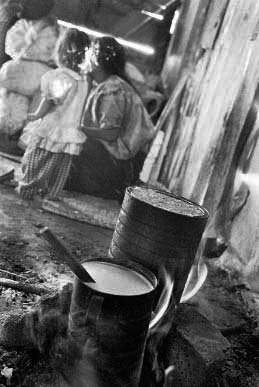
Inside of the shacks, food is cooked and heated on a three-stone fire. The fires have no chimneys, and create billows of smoke that hang inside the shack. This smoke is the source of many respiratory diseases in women and children and often causes the women to go blind by age 40.
Manley and his peers used their masonry skill to create small cookstoves, and attached chimneys to the cookstoves to clear the air. The criteria they used to determine who received a cookstove was "the size of the family, because we wanted to make a difference in the lives of as many children as possible," Manley said in a pamphlet he's written about the trip.
The cookstoves allow families to live without smoke. Also, they retain some heat, and so become integral to keeping the family warm.
Twenty-six cookstoves were built last year. This year, Manley and his team aim to build 50. Money for the stoves is donated "by people who want to make a difference," said Manley in his pamphlet.
Manley has been a mason since 1977 and became interested in European-style masonry heaters early in his career. He took trips to Finland, Sweden and Russia to learn how masonry heaters are built.
Masonry heaters are made of firebrick and regular brick, and they take up a vast portion of a central room in a house. Their large size and thickness allows large fires to burn without creosote buildup, and they radiate heat for nearly 24 hours after the fire has gone out.
"Once you discover something like this exists, you end up wanting one. Everybody has to heat their house," Manley said. "And if you're going to heat with wood, this is the cleanest way to do it. These heaters have been around for 400 years, and they're the standard in Europe."
Manley not only creates large brick heaters, but ovens, too. "I made the ovens at Cafe Miranda and Primo's in Rockland. I also did Fore Street in Portland."
The elegance and fine cuisine at these Maine coast restaurants is a far cry from what Manley experiences while he's in Guatemala. There is little food, warmth or shelter in the high mountains. However, there is health and warmth for some of the Mayans of Ixtahuacan, thanks to Manley and other masons' work.
It costs $150 to purchase the materials necessary for a stove in Guatemala.
To contact Pat Manley or to make a contribution, email jpmanley@midcoast.com.
Guatemala Stove Project
(Editor's note, 2025): This is still online and active as a separate group at http://www.guatemalastoveproject.org/
Griot Photo Essay of Guatemala Relocation
(Editor's note, 2025): This website is down, and some photos are lost. This is all that remains available.
Relocation: the new village of Santa Catarina Ixtahuacan
On January 11th, 2000, the people of Santa Catarina Ixtahuacan packed up their homes, carried their belongings more than 15 kilometres away, up the hills of Highland Guatemala, and established a new village. Driven by recurrent tremors and the devastation of Hurricane Mitch in November 1998 (during which 2 people died and much of the town was demolished by rampaging rivers and mudslides), the citizens of Ixtahuacan were faced with a grueling mountaintop nicknamed "Alaska" because of the morning frost. Pushed by fear of cracks in their homes and divisions among themselves, the leaders of the village persuaded the villagers to move. The following photo essay is about this difficult decision.




https://web.archive.org/web/20070705061230/http://www.griotphoto.org/new_page_5.htm
No Comments