
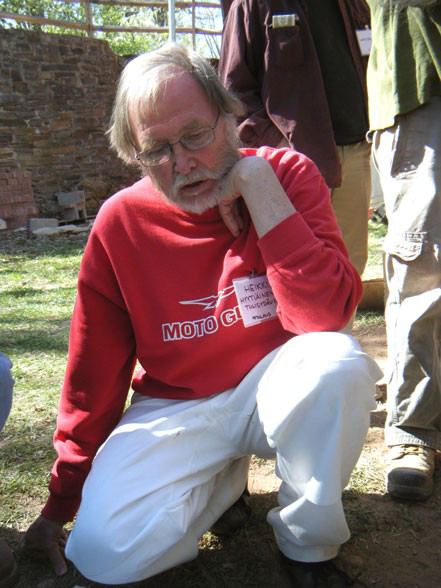
In memoriam of Heikki Hyytiäinen, by Albie Barden
Extremely important historical account of Albie Barden's 1978 visit to Finland regarding masonry heaters, the possible founding roots of the MHA, the accomplishments of Heikki Hyytiäinen, including the introduction of Tulikivi into the United States.
Original
Transcript
In the winter of 1978, we (Albie and Cheryl Barden with their son Scott in a backpack), traveled for three weeks throughout central and northern Europe on a Eurail pass researching the then current status of masonry heater know-how in several countries. We traveled by rail to France, Switzerland, Austria, Germany, Denmark, and Sweden and by an ice breaker from Stockholm, Sweden to Helsinki, Finland. In the offices of the national Rakennuskirja Oy (Building Book Ltd) we were greeted warmly by a shy co-operative lady who remembered letters of inquiry about masonry heaters that Albie had sent to them months earlier.
While we waited in the lounge, this wonderful woman went back through 40 years of masonry heater related publications and plans and came out after twenty minutes with a thick sheaf of technical drawings and documents to take home with us. We also learned through her that Finland still had a very active masonry heater tradition in place which included a large company making high quality cast iron doors and hardware for heaters, and a company making mortar specially designed for masonry heaters, and a technical school where young people where being trained to build masonry heaters. We also learned that the Finnish fireplace tradition centered around brick units with front and center fire box doors. This combination of industrial and educational assets, plus a basic design that looked like a first cousin to New England's brick open fireplace tradition, helped the Bardens realize that their best chance for bringing the European masonry heater tradition to New England and the rest of the States and Canada, was their new Finnish connections.
A few months after our winter of 1978 visit, the same woman who had greeted us in the Building Book Ltd. offices, sent Albie a new book, which they had just published, written in Finnish, by a local architect, university professor, magazine editor, and masonry heater enthusiast named Heikki Hyytiäinen, Published in black and white, the book Muuratut Tulisijat, was filled with wonderful photographs and very many scaled drawings of new and old Finnish masonry heaters, ovens, and cookstove designs.
Albie was thrilled to receive the book and was working on his own “Russian” fireplace designat the time with his, now, life long friend Doug Wood of Thetford, Vermont. Albie said to Doug, “Let's call Heikki out of the blue and invite ourselves to Finland for a week to be shown all the most important features of Finland's historic and current masonry heater activities.” Doug thought it was a good idea, so without any warning or prior introduction, we cold-called Heikki (who spoke, as many educated Finns do, 5 or 6 languages, including English). He picked up the phone and after a brief introduction, I asked him if we could come to Finland soon and have him host and guide us for a week to all that was important regarding masonry heaters. After a five second pause, Heikki said “yes”. He set no conditions. We arrived a month or so after our call and stayed with Heikki and his daughters Helena and Hilkka and his partner Aila. We visited the big museum in Helsinki with Heikki and his daughters and admired heater after heater set up in a large number of restored rooms. One restored bedroom had a beautiful painted tile heater in one corner of the room and a matching wooden wardrobe “heater” in the opposite corner of the room. There was a tiny one room log cabin (smoke hut) finished with a large oven, a single table with two benches and a bed. The cabin had no chimney, but rather a little trap door in the roof which was propped open during the oven burn and closed when the burn was completed. The oven was uninsulated. It served as the only cooking, baking and heating unit in the tiny log cabin.
We travelled with Heikki to a cousin's house to see heaters there and a handmade sauna building and a low profile brick barn made from hand formed bricks of clay and sand which his cousin had pressed one at a time and fired in an outdoor stacked green brick kiln. Heikki's extended family, along with many thousands of other Finns, had been forced to leave their homeland of Karelia, in Eastern Finland, when Russia annexed roughly 1/3 of Finland to create a buffer East of St. Petersburg. We visited the local vocational school and watched several heater and ovens being built there.
We visited the local foundry making castings for heaters and the factory making mortar for heaters, as well as other uses and were then treated to a traditional wood fired Savu Sauna (smoke sauna) where careful track was kept of the high temperature achieved. After several alternating sweats and rolls in thesnow, we all sat in a dressing room with only our linen towels and ate a grand chicken meal with other goodies. Albie asked the mortar company and casting companies if they would like to partner with us in the U.S. and yes they would. We shook hands, signed no contracts, and a forty year friendship and partnership was begun.
Heikki planned our trip and drove us around to all these places in his modest car and he and Aila gave us beds in their Helsinki apartment. They essentially made us a part of their family. They did all this at their own expense.
We decided to organize the first Finnish Fireplace hands-on workshop in the States in the early summer of that year and found a willing homeowner to host this event in Lincolnville, Maine. Heikki led the workshop, building a brick heater with perhaps as many as 12 masons attending, including Norbert Senf, Steve Bush, Doug Wood, and others, several of whom arrived on motorcycles. In gratitude to Heikki and his family, Doug Wood and Albie hosted Heikki and his daughter for three weeks and our families and gave them tours of DC, NYC, and Cambridge, MA where his famous mentor, Alvar Alto, had designed a large building for Harvard using “clinker” bricks as the main building block and design element. This workshop began the formal Finnish Fireplace building tradition in the States.
It is interesting that an earlier Finnish heater researcher named Asp had experimented with secondary air introduced over the fire and we added our own Asp inspired small diameter black iron tubes to this first heater. Iron only holds up if air is moving through it during each firing and these modest air tubes eventually burned up. When our client doubled the size of his little Cape several years later we built another Finnish Fireplace in the new part of the home and rebuilt the firebox on the original heater.
With Heikki's growing interest in masonry heater and masonry heater research, he left his teaching work and magazine Muoto (“form”) editing work and started his own little heater company called Tulisydan in a farm building outside of Helsinki which had once housed pigs. His shop and labwere therefore always affectionally referred to as the Piggery. Heikki wrote another book on masonry heaters in Finnish for the Building Book Ltd and this color book, full of more photos and drawings was called Tulisijat Ja Sydänmuurit.
Heikki returned to the States in the early eighties with Erkki Salmela, his long time master mason ally, and mentor. At a new home project on Long Island, NY. Heikki, Erkki, and Albie led a twenty person hands-on workshop with four/five person crews. Each crew worked a half day on the either the chimney, a bake oven, a heater or a mixing-tending crew. Despite severe stormy weather, a leaky roof, and flooding, which swept several tents away, we completed a handsome project. It is said that the beginning of the Masonry Heater Association had roots in this workshop. Years later the same client had my son Scott come back to build a second large brick heater in a new addition to the home.
For several years Albie worked to bring Tulikivi to the States and he organized with Heikki, a hands-on workshop in Finland for about twenty male and female masons. Near Helsinki and under Heikki and Erkki's guidance, we built a brick cookstove and the first heater with an upper chamber oven that we had ever seen. We then all hopped aboard an overnight sleeper train with Heikki and Aila, to Joensuu located in Eastern Finland. From there we travelled as a group by bus to the top of a small mountain overlooking Lake Pielinen where our Tulikivi host Reijo Vauhkonen asked us to be quiet and listen for the birds of May who sing beautifully during this first warm season of the year. As we all hushed, the á cappella voices of a hidden Karelian choir serenaded us from behind huge boulders, giving us a magic welcome to the area. We came down the small mountain and boarded a boat that took us across the lake from which the ice had gone out only the day before. In a long log lodge on the late shore, several women in traditional clothing served us a magnificent meal and we all then walked to a huge sauna at the lake's edge and joined with a German Tulikivi dealer group. We sweated and celebrated together, running down to the dock and plunging into the icy lake after each round. Our group stayed in a nearby gigantic log lodge and with Heikki as our tour guide and Reijo V as the Tulikivi owner and host, we visited the Tulikivi factory and were given much coveted orange jumpsuits that the shop employees wear. We went to a number of local homes featuring modern Tulikivi masonry heaters as well as historic soapstone heaters with open hearths and sleeping platforms accessed by stairs to the top of the ovens. The food and hospitality was extraordinary. Several people in the group eventually became Tulikivi dealers or distributors. Maine Wood Heat became the initial importer and distributor and by setting up dealers and distributors, we were able to sell 100 units in the first year.
With the support of the export manager, Pekka Gronberg, of the Upo Foundery, it was decided to write a book on Finnish Fireplaces co-authored by Albie and Heikki. Heikki did most of the heavy lifting, including all drawings and technical details and all the layout for the book. Albie helped with local photos and a careful edit of the text. The 2000 book limited edition sold out after a very few years and helped keep the interest in Finnish Fireplaces going.
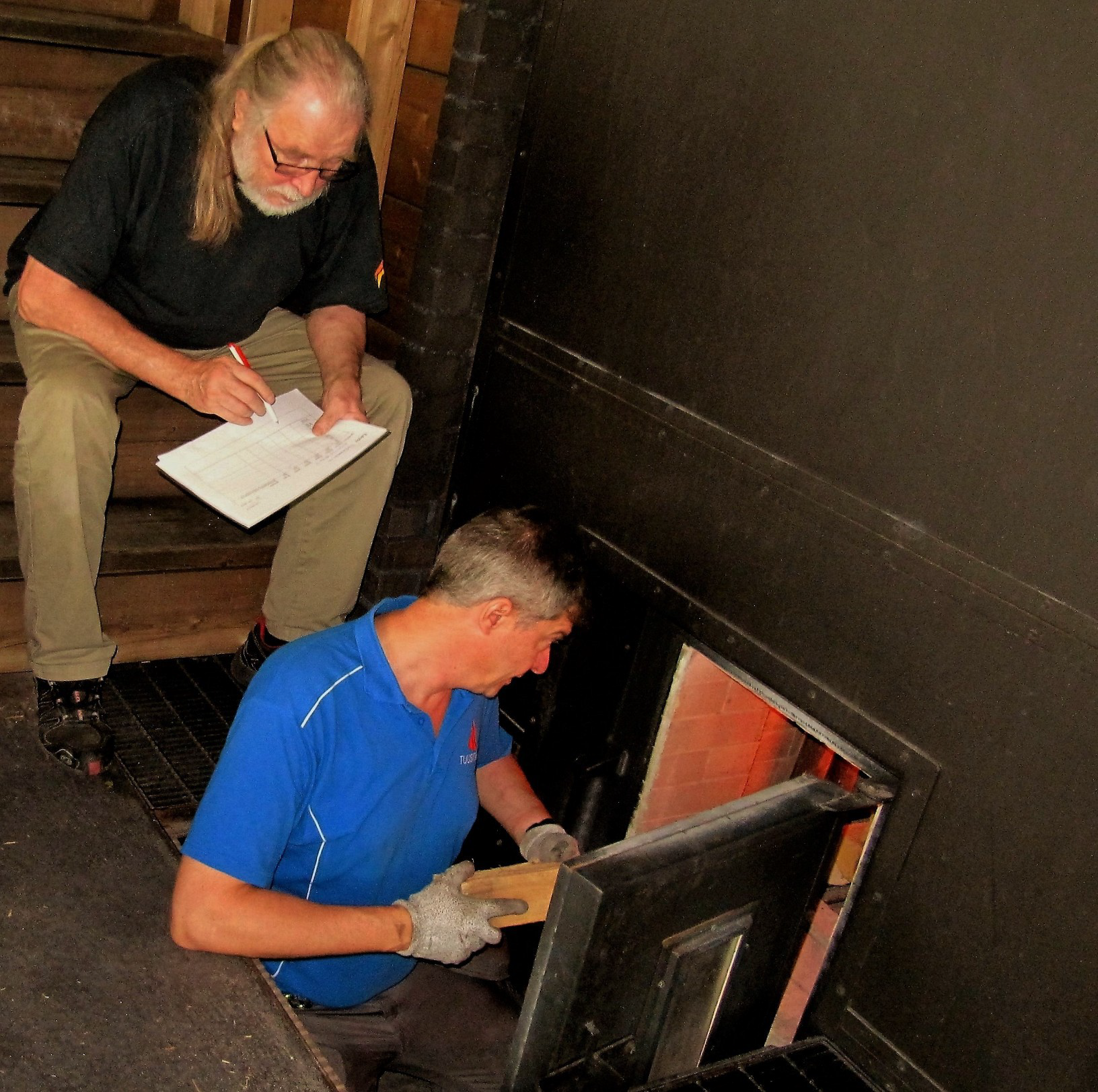
In Finland, Heikki became a leading figure in the growth of the Masonry Heater Movement there. He was also hired to design and build several different soapstone fireplaces in the new presidential mason in Helsinki. Each unit had a distinctly different look. Heikki became a very serious researcher in masonry heater design and clean emissions, and developed this own “Firebox” design which featured secondary air tubes delivering 2/3 of the pre-heated combustion air supply above the fuel charge from both sides of the firebox. The air jets created interlocking “fingers” of fresh turbulent preheated oxygen to create exceptional gas combustion. 1/3 of the air came through the floor covered entirely of grates. He shipped two of these units to the States. One was assembled at Wildacres where it received little notice. The second was shipped to Ben Myron's lab where three of us assembled the unit and then watched Ben conduct three tests on the unit. Using the new ASTM unit cordwood burn protocol, Heikki's unit achieved the lowest emissions rating of any masonry unit that has ever been tested in the States or Canada. I recall that in one of the other tests (Colorado), we began with a kindling charge. We could not add the main charge of fuel until the kindling charge had been reduced to almost nothing. This would never be the way a masonry heater would be burned in the real world. At the end of the kindling burn, there was a square string of fiery coals around the perimeter of the firebox, looking like a rope around a boxing ring. The coals could not be touched. When the main charge was added to this thin rope of coals, it took a few moments for the charge to ignite and get back into clean combustion. It was no wonder that the unit did not fare so well in this test. It taught us the lesson that a manufacturer must be able to specify how his or her unit should be fired.
A few years ago Heikki came again to WildAcres and spoke briefly to the group as a whole and to the EPA rep more privately. He shared with everyone his findings on clean combustion and shared the health dangers of the tiny particulates associated with incomplete wood combustion in Europe. There, Heikki held several workshops, often in eco-villages, where he built and installed his high efficiency heaters with his patent pending Firebox modular core design. In the last years of his life, Heikki's little company was hired to design and build two or more very large, very clean burning saunas for the city of Helsinki. While building masonry haters, Heikki was also asked to design and build several clean burning commercial wood fired bake ovens. Tom Trout and Doug Wood assisted in the construction of one such oven in the King's Garden in Stockholm.
Heikki wanted to publish one more book on Masonry Heaters, sharing his latest knowledge on design and clean combustion. Heikki asked Albie to edit the English version of the book and pages of the draft manuscript went back and forth to Finland many times. The book is complete, however it was not published.
Heikki was an incredible experimenter. He ran over 1000 computer monitored tests during the evolution of his “Firebox” design. He built over half a dozen wood burning appliances at his country home. He figured out a way to speed dry split green wood during the summer season by stacking the wood in a simple vented plastic “greenhouse” woodshed.
The history of modern masonry heaters in North America has deep roots in the passion, intelligence, and generosity of Heikki. “Mr. Smoke” was always happy with the results of Heikki's work.
Albie Barden
No Comments